lunes, 24 de septiembre de 2018


past progressive and simple past

1. Use

Simple PastPast Progressive
  • action finished in the past (single or repeated)
  • series of completed actions in the past
  • action was in progress at a special time in the past
  • two actions were happening at the same time (the actions do not influence each other)

2. Form

Simple PastPast Progressive
  • regular verbs: infinitive + -ed
  •  irregular verbs: 2nd column of the table of the irregular verbs
(was or were) + infinitive + -ing

3. Examples

3.1. Affirmative sentences

Simple PastPast Progressive
played football.He was playing football.
You played football.You were playing football.
He played football.He was playing football.

3.2. Negative sentences

Simple PastPast Progressive
did not play football.He was not playing football.
You did not play football.You were not playing football.
He did not play football.He was not playing football.

3.3. Questions

Simple PastPast Progressive
Did I play football?Was I playing football?
Did you play football?Were you playing football?
Did he play football?Was he playing football?

4. Spelling

Simple PastPast Progressive
  • stopped (Double the consonant after a short vowel.)
  • loved (one -e at the end of the word → Add only -d.)
  • worried (consonant before -y → Change to -i.)
  • sitting (Double the consonant after a short vowel.)
  • writing (Drop the -e.)
  • lying (Change -ie to -y.)

5. Use

Both tenses are often used in one sentence:
While we were sitting at the breakfast table, the telephone rang.
We were sitting at the breakfast table when the telephone rang.
  • Past Progressive → we were sitting at the table
  • Simple Past → the telephone rang.
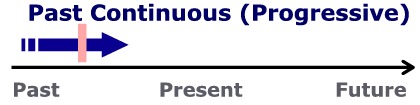
The action in the Simple Past (pink) interrupts the action in the Past Progressive (blue).
Exceptions
Exceptions when adding 'ed' :
  • when the final letter is e, only add d.
    Example: love - loved
  • after a short, stressed vowel, the final consonant is doubled
    Example: admit - admitted
  • final l is always doubled in British English (not in American English)
    Example: travel - travelled
  • after a consonant, final y becomes i. (but: not after a vowel)
    Example: worry - he worried
    but: play - he played
Exceptions when adding 'ing' :
  • silent e is dropped (but: does not apply for -ee)
    Example: come - coming
    but: agree - agreeing
  • after a short, stressed vowel, the final consonant is doubled
    Example: sit - sitting
  • final l is always doubled in British English (not in American English)
    Example: travel - travelling
  • final ie becomes y.
    Example: lie - lying
Utilizamos estos dos tiempos verbales cuando una acción es interrumpida por otra acción en el pasado. Existen dos partes de estas oraciones:
1. Cuando hablamos de una acción que se encuentra en progreso en el pasado, utilizamos el “pasado continuo o progresivo
-I was taking a shower (Estaba tomando una ducha)

2. La acción que interrumpe utiliza siempre el “pasado simple”:
-when the phone rang (Cuando el teléfono sonó)

La acción “sonó el teléfono” interrumpe a la acción “estaba tomando una ducha.

Otros ejemplos:
-Tim was cooking when his wife got home. (Tim estaba cocinando cuando su esposa llegó a casa)

-What were you going when the accident happened? (¿Qué estabas haciendo cuando el accidente ocurrió?)


-They weren’t doing anything when I called them. (Ellos no estaban haciendo nada cuando los llamé)

Recuerda que también podemos cambiar el orden de la oración sin modificar el significado. Es importante utilizar un signo de coma “,” para dividir las oraciones.
-When Annie got home, Tim was cooking. (Cuando Annie llegó a casa, Tim estaba cocinando)
También es posible usar la palabra “while” que significa “mientras”, ejemplos:
-Someone broke into my house while I was sleeping. (Alguien asaltó mi casa mientras yo dormía)
-He shouted at her while she was driving (Él le grito a ella mientras ella estaba conduciendo)


jueves, 20 de septiembre de 2018


Simple past


Estructura:


The form of the past simple is the same for all persons (I, you, he, she, it, we, you, they).


-The regular verbs form the “past simple” by adding -ed to the base form of the verb.


Verb (base form) + -ED

start / started
jump  jumped

There is only one form of the verb in the past tense.


These exceptions are dependent from the last letter of the base
form of the verb.
-If the verb ends in -E, we add only -D to form the past simple.

Verb (base form) + -D

Live /  lived
save / saved
change / changed


-If the verb ends in a consonant preceded by a single vowel, we
double the final consonant and we add -ED to form the past simple.

Verb (base form) + final consonant + -ED

stop / stopped
plan /  planned
flip / flipped

-If the verb ends in -y preceded by a consonant, we change Y with
I, then we add -ED.

Verb (base form y i) + -ED

study / studied
cry / cried
marry / married


Remember...

-If the verb ends in -y preceded by a vowel, we regularly add -ED.
play played

-If the verb ends in -L, we double the L and we add -ED.

Verb (base form) + -L + -ED
travel travelled
label labelled


Ejemplos oraciones pasado simple en inglés


El pasado de los verbos regulares se forma escribiendo ed al final del verbo en su forma simple para todos las personas. Cuando el verbo termina en y, se elimina la y y se escribe ied al final: study cambia a studied. Cuando el verbo termina en e solo se escribe una d al final: live cambia a lived.
Ejemplos:
  1. You worked very hard last week. (Tú trabajaste muy duro la semana pasada)
  2. She lived in Japan last year. (Ella vivió en Japón el año pasado)
  3. They learned how to swim two years ago. (Ellos aprendieron a nadar hace dos años)
  4. She liked to sit  in the sun. (A ella le gustó sentarse en el sol)
  5. He always walked to school. (Él siempre caminó para ir a la escuela)
  6. I painted my house last weekend. (Yo pinté mi casa el fin de semana pasado)
  7. Mr. Green worked with my uncle. (El Sr. Green trabajó con mi tío)
  8. I married Kelly last year. (Me casé con Kelly el año pasado)
  9. He worked in his garden yesterday. (El trabajó en su jardín ayer)
  10. He studied for his English class. (Él estudió para su clase de inglés)
  11. You watched television every night. (Usted vio televisión todas las noches)
Ejemplo con video:


PAST PROGRESSIVE


La estructura de una oración de pasado progresivo, esta formado de la siguiente manera:


The activity began before the action expresses by the simple past. La acción comenzó antes que la acción expresada por el pasado simple, es decir, muchas veces al comunicar vamos a cambiar el paso simple y el continuo.
El pasado continuo comunica acciones o detalles que están sucediendo estaban en progreso, o aun no terminaban.


  •    She was baking a cake when we arrived (ella estaba horneando un pastel cuando nosotros llegamos)


  •      When i found patricio he was eating breakfast (cuando yo encontre a patricio el estaba comiendo su desayuno)


La estructura para las oraciones afirmativas es la siguiente:


La estructura para las oraciones negativa es la siguiente:


La estructura para las oraciones interrogativa es la siguiente:


The PAST PROGRESSIVE TENSE indicates continuing action, something that was happening, going on, at some point in the past. This tense is formed with the helping "to be" verb, in the past tense, plus the present participle of the verb (with an -ing ending).


Examples:


La manera corta de contestar de manera afirmativa o negativa es la siguiente:


Reglas para agregar correctamente la terminacion “ing”a los verbos partiendo de suforma basica.If a verb ends in_ie, ie changes to y before the ending_ing.


Sometimes a verb ends in vowen + consonant, we need to double the consonant at the end and add _ing


A continuación se explica el past progressive con un vídeo:


14 de febrero 
El día de San Valentín, es una festividad de origen cristiana que se celebra anualmente el 14 de febrero como conmemoración a las buenas obras realizada por san Valentín de Roma que están relacionadas con el concepto universal del amor y la afectividad. Originado por la Iglesia católica como contrapeso de las festividades paganas que se realizaban en el Imperio romano, también es una de las primeras fiestas que significaron la expansión del cristianismo en toda la Eufrasia romana, la fiesta en sí es conocida como un evento cultural significativo desde lo religioso por la gracia a Valentín y desde lo laico por relacionarse con los sentimientos del amor y la amistad.
A pesar del reconocimiento de san Valentín de Roma como el fundador e iniciador de la fiesta el 14 de febrero también se asocia a otros religiosos mártires con el nombre Valentín​ esto no socavó la leyenda principal en la que se fundamenta la festividad: San Valentín casaba a soldados con sus damas en las bodegas de las cárceles del Imperio en los tiempos que el cristianismo fue prohibido por Claudio II, este último enterado de los votos matrimoniales que realizaba el santo, mandó capturarlo y traerlo frente a él para que se excusara, al parecer Claudio no tenía más intención que solo reprenderlo y expulsarlo del país pero por influencia de otros altos funcionarios mandó decapitar a san Valentín.  Los días que estuvo esperando en prisión para su ejecución vio que la hija del juez de la prisión era ciega, él por medio de oraciones pidió a Dios que la joven tuviera la dicha de poder ver, durante su traslado a la plaza pública para su ejecución San Valentín le regaló un papelillo a la joven para que lo lea, ella sin entender el motivo ya que era ciega abrió el papel y por primera vez logró ver y lo primero que vio era una frase que decía «Tú Valentín» como forma de despedida.​ Algunos historiadores que apoyan este relato como el único y verdadero aseguran que Valentín se llegó a enamorar de la joven, por lo cual su simbolismo como santo del amor fue mayor.
Actualmente los mexicanos conocen el 14 de febrero como el día del amor y la amistad y regalan chocolates o un oso de peluche en el Día del Amor y la Amistad suena como algo que haría una pareja en los años 80, pero la realidad es que en el imaginario colectivo de los mexicanos los regalos cliché de San Valentín siguen siendo muy populares.


Resultado de imagen para 14 de febrero

Gerund phrases as subject and object Both  would rather  and  would prefer  are used to express preferences in English. Here are some ex...