past progressive and simple past
1. Use
| Simple Past | Past Progressive |
|---|---|
|
|
2. Form
| Simple Past | Past Progressive |
|---|---|
| (was or were) + infinitive + -ing |
3. Examples
3.1. Affirmative sentences
| Simple Past | Past Progressive |
|---|---|
| I played football. | He was playing football. |
| You played football. | You were playing football. |
| He played football. | He was playing football. |
3.2. Negative sentences
| Simple Past | Past Progressive |
|---|---|
| I did not play football. | He was not playing football. |
| You did not play football. | You were not playing football. |
| He did not play football. | He was not playing football. |
3.3. Questions
| Simple Past | Past Progressive |
|---|---|
| Did I play football? | Was I playing football? |
| Did you play football? | Were you playing football? |
| Did he play football? | Was he playing football? |
4. Spelling
| Simple Past | Past Progressive |
|---|---|
|
|
5. Use
Both tenses are often used in one sentence:
While we were sitting at the breakfast table, the telephone rang.
We were sitting at the breakfast table when the telephone rang.
- Past Progressive → we were sitting at the table
- Simple Past → the telephone rang.
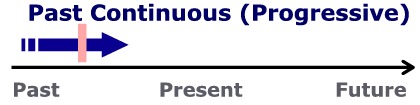
The action in the Simple Past (pink) interrupts the action in the Past Progressive (blue).
| Exceptions | |
Exceptions when adding 'ed' :
| Exceptions when adding 'ing' :
|
Utilizamos estos dos tiempos verbales cuando una acción es interrumpida por otra acción en el pasado. Existen dos partes de estas oraciones:
1. Cuando hablamos de una acción que se encuentra en progreso en el pasado, utilizamos el “pasado continuo o progresivo”
-I was taking a shower (Estaba tomando una ducha)
2. La acción que interrumpe utiliza siempre el “pasado simple”:
-when the phone rang (Cuando el teléfono sonó)
La acción “sonó el teléfono” interrumpe a la acción “estaba tomando una ducha”.
Otros ejemplos:
-Tim was cooking when his wife got home. (Tim estaba cocinando cuando su esposa llegó a casa)
-What were you going when the accident happened? (¿Qué estabas haciendo cuando el accidente ocurrió?)
-They weren’t doing anything when I called them. (Ellos no estaban haciendo nada cuando los llamé)
-What were you going when the accident happened? (¿Qué estabas haciendo cuando el accidente ocurrió?)
-They weren’t doing anything when I called them. (Ellos no estaban haciendo nada cuando los llamé)
Recuerda que también podemos cambiar el orden de la oración sin modificar el significado. Es importante utilizar un signo de coma “,” para dividir las oraciones.
-When Annie got home, Tim was cooking. (Cuando Annie llegó a casa, Tim estaba cocinando)
También es posible usar la palabra “while” que significa “mientras”, ejemplos:
-Someone broke into my house while I was sleeping. (Alguien asaltó mi casa mientras yo dormía)
-He shouted at her while she was driving (Él le grito a ella mientras ella estaba conduciendo)


No hay comentarios:
Publicar un comentario